
Why Digital Marketing Matters for Small Trades and Home Service Businesses
Good work still matters. But good work alone does not guarantee that customers will find your business.
When a pipe bursts, an air conditioner stops working, or a homeowner needs a roofer, electrician, landscaper, or handyman, the search often starts online. The businesses that appear at the right time, look trustworthy, and respond quickly have a better chance of winning the job.
That is the real value of digital marketing. It helps your business get found when someone already needs what you do.
Digital Marketing Reaches People With a Problem to Solve
Traditional advertising can build awareness, but digital marketing can reach customers with clear intent. Someone searching for “emergency plumber near me” is not casually browsing. They are looking for help.
Google Search Ads and Local Services Ads can place a business near the top of those results. Google explains that Local Services Ads appear prominently for relevant local searches and use a pay-per-lead model, meaning the business generally pays when a prospective customer calls, sends a message, or books through the ad.
Industry data supports the importance of search. According to CallRail’s 2026 home services marketing research, home service businesses ranked paid search and SEO as their two most important channels for driving new business.
Digital marketing also helps establish trust before the first call. BrightLocal’s 2026 Local Consumer Review Survey found that 97% of consumers read reviews for local businesses. Positive reviews make 85% of consumers more likely to use a business, and 54% visit the company’s website after reading them.
Your website, reviews, photos, service pages, and Google Business Profile work together. They show homeowners that your business is active, professional, and prepared to help.
For a busy plumber or HVAC tech, this means fewer empty slots and more predictable revenue. Instead of relying solely on word-of-mouth or driving around for work, digital marketing puts your business in front of homeowners right when they need you—often while you’re already on another job.
What Is a Reasonable Advertising Budget?
There is no single correct budget. Plumbing, roofing, HVAC, remodeling, lawn care, cleaning, and handyman services have different job values and levels of competition.
For a solo operator or small team targeting one service area, $1,000 to $2,000 per month in ad spend can provide a reasonable starting test. A business in a competitive market, targeting several services, or selling higher-value work may need $2,500 to $5,000 or more per month.
That is the media budget paid to platforms such as Google. Website work, call tracking, content creation, and campaign management may be separate costs.
LocaliQ’s 2025 home services advertising benchmarks found average costs per lead ranging from approximately $29 to $101 across home service categories. At a $75 cost per lead, a $500 monthly budget may produce only six or seven leads. That is often too little activity to judge whether a campaign is working right away and may require several months for enough data to make an appropriate call.
A better budget starts with job economics:
- How much gross profit does an average job produce?
- How many leads become booked appointments?
- How many appointments turn into paying jobs?
- What can the business afford to spend to gain a new customer?
Example: If your average plumbing job has $800 gross profit, a 30% close rate on leads, and you want to spend no more than 15–20% of revenue on customer acquisition, you can afford ~$150–$250 per lead. Track this in your CRM dashboard such as Jobber or Jobtable (affiliate links), to see what’s working.
If a $200 customer acquisition cost produces a job with $750 in gross profit, the advertising may be working well. If it produces a $250 job with high labor and material costs, it probably is not.
How Long Does Digital Marketing Take to Work?
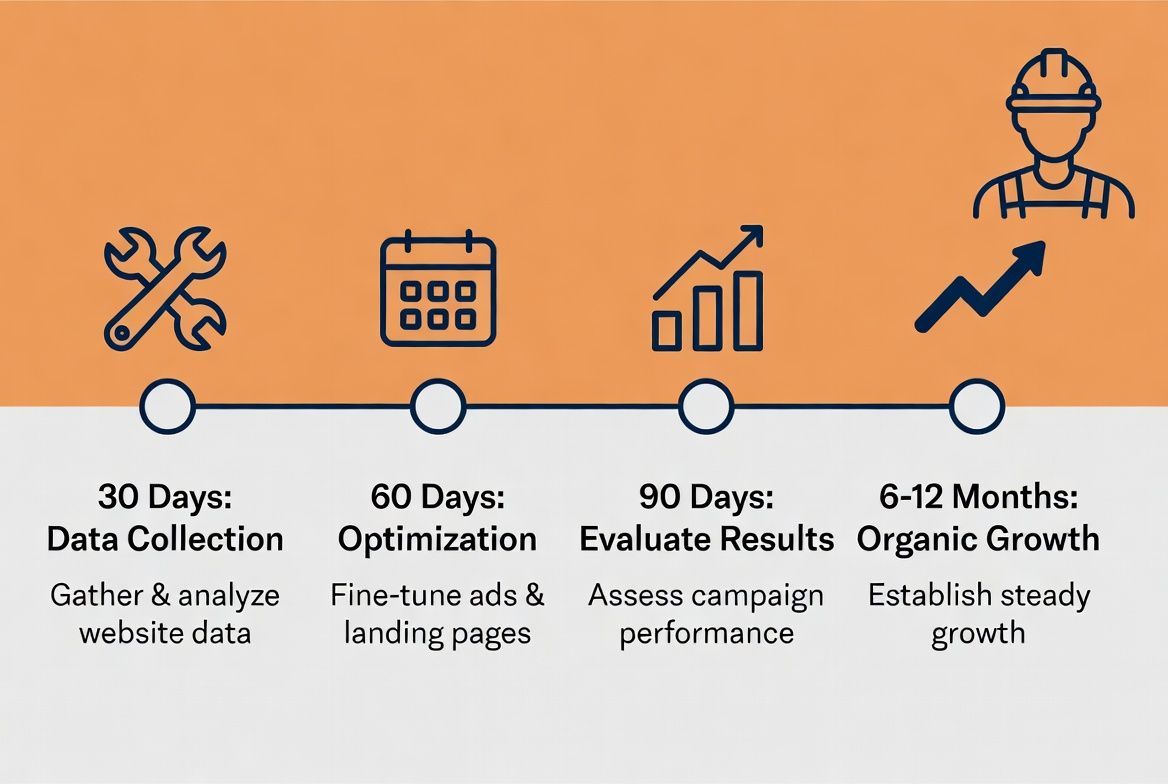
Paid search can begin producing visibility and leads within days, but that does not mean the campaign is fully optimized.
A practical planning window is:
- First 30 days: collect data and identify weak keywords, locations, ads, and search terms.
- Days 30–60: improve targeting, reduce wasted spending, and strengthen conversion tracking.
- By 90 days: evaluate lead quality, booking rates, customer acquisition cost, and revenue.
Pro tip: Use call tracking from day one. It shows exactly which ads or keywords bring in calls that turn into jobs, critical for busy owners who can’t afford guesswork.
Organic search takes longer. A Google Business Profile, review strategy, helpful website content, and local SEO may show early progress within three to six months. Strong, lasting organic visibility often requires six to twelve months of steady work.
Marketing should be treated as a system that improves; not a switch that produces perfect results immediately.
How Digital Marketing Works in Home Services
An emergency plumber can use paid search and Local Services Ads to reach homeowners with urgent problems.
An HVAC company can advertise tune-ups before peak cooling or heating season, then increase emergency-repair spending when temperatures change.
A roofer or remodeler can use project photos, before-and-after videos, customer reviews, and local service pages to build confidence around higher-value work.
Handyman or landscaping businesses can run targeted campaigns to past customers for seasonal tune-ups or 'spring clean-up specials,' turning one-time jobs into recurring work.
A landscaper, cleaner, or maintenance company can use email, text, and targeted local campaigns to reactivate past customers and fill gaps in the schedule.
These efforts can help smooth out down periods. Instead of waiting until the calendar is empty, a business can begin promoting seasonal services several weeks ahead of an expected slowdown.
The mistake is turning marketing off whenever the business gets busy and restarting only after the work disappears. That creates the same feast-or-famine cycle marketing is supposed to fix.
Marketing Cannot Fix Poor Follow-Up
More leads will not help if calls go unanswered or estimates never receive follow-up. CallRail found that 66% of home service businesses identified lead follow-up and conversion as a major operational challenge.
Digital marketing works best when it is connected to good operations: call tracking, fast responses, clear estimates, scheduled follow-ups, professional customer communication, and accurate reporting.
For small trades and home service businesses, marketing is not just about getting attention. It is about creating a more dependable flow of opportunities, learning what produces profitable work, and building a business that does not depend only on referrals or good weather.
Start small: Claim and optimize your free Google Business Profile with photos, services, and hours. Then test $500–$1,000/month in Google Ads or LSAs. Pair it with fast response systems such as text alerts, automated follow-ups in Jobber, and team training on estimates. Many businesses see results in weeks when operations support the leads.
Done correctly, digital marketing becomes more than an expense. It becomes a controllable system for generating demand.
Sources Referenced
- Google — How to Grow Your Business With Local Services Ads
- Google — Understanding SEO and PPC
- CallRail — Home Services Marketing Trends for 2026
- BrightLocal — 2026 Local Consumer Review Survey
- LocaliQ — Home Services Advertising Benchmarks
- Jobber — 2026 Home Service Trends Report
Data from 2025–2026 reports; results vary by market.
Affiliate Disclosure: This page contains affiliate links. If you click on these links and make a purchase, we may receive a small commission at no additional cost to you. This helps support the site and allows us to continue providing helpful content.